CCM: Care Manager Assistant
Fast, source-backed answers for everyday CCM education questions.
Quick Topics
Safety Boundary
CCM Quick Start
Designed for the questions care managers hear every day. Start with the patient’s question, symptom, medication, lab, or referral instead of hunting through separate websites.
Choose questions that fit this call.
Choose a call style or health area, then pull a fresh mix of questions. Use this to keep monthly conversations varied, uncover goals and barriers, and explore concerns without turning the call into a checklist.
Choose a set below
Change question set
General Health
Prompts below are unused until asked and answered. Checked means asked; saved documentation is reviewed separately in the Call Tray.
Saved answers in this workspace: 0 Call Tray items.
Provider Message Assistant
G/B/S/O Guide
Check the questions you use and record only confirmed answers. Review the paragraph, then add or update it in the Call Tray.
Call Time Guideline
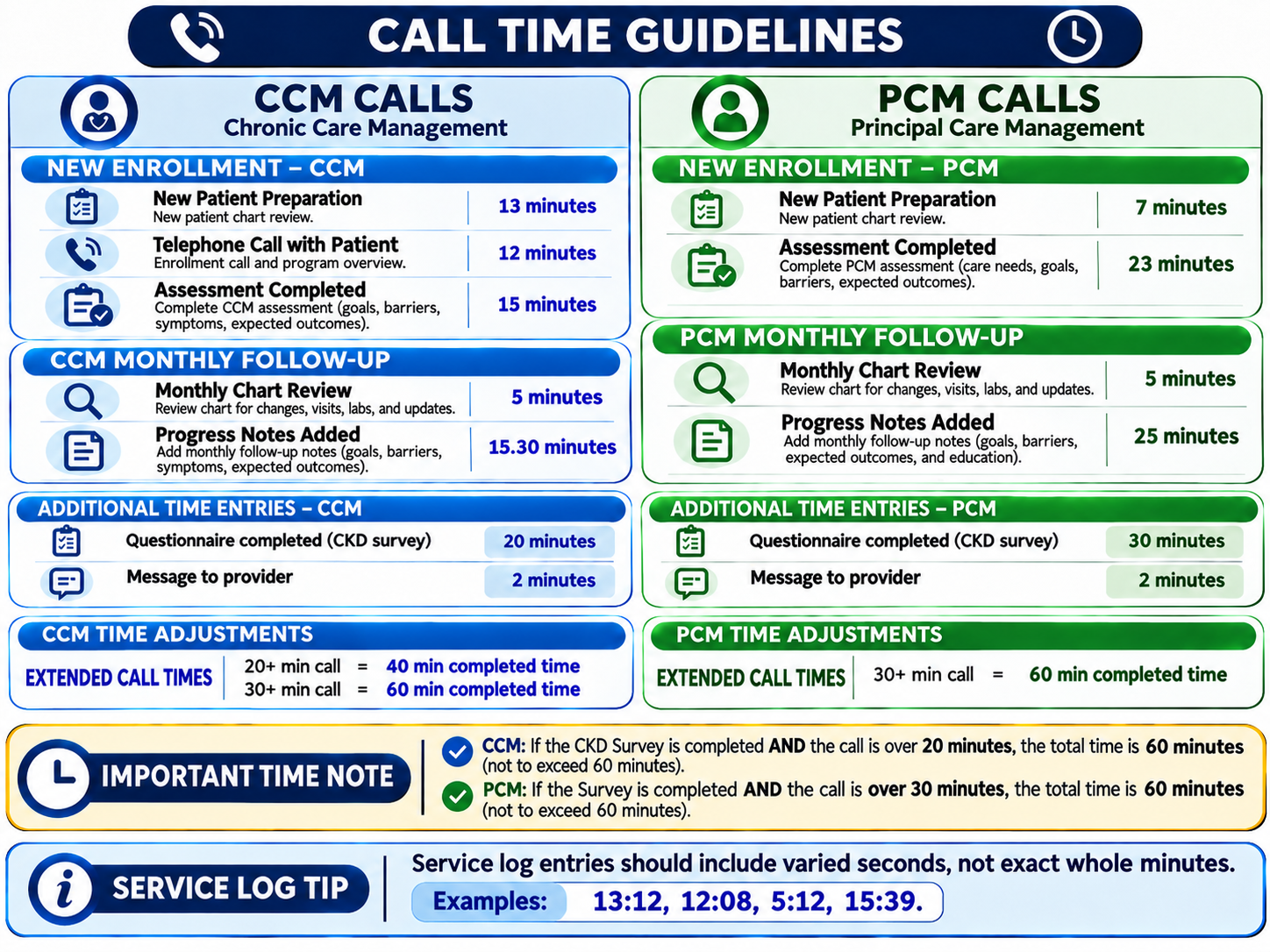
Open full-size graphic (new tab)
Read the guidelines as text
CCM new enrollment
- New patient preparation (chart review) — 13 minutes
- Telephone call with patient (enrollment and program overview) — 12 minutes
- Assessment completed (goals, barriers, symptoms, and expected outcomes) — 15 minutes
CCM monthly follow-up
- Monthly chart review (changes, visits, labs, and updates) — 5 minutes
- Progress notes added (goals, barriers, symptoms, and expected outcomes) — 15.30 minutes
CCM additional time entries
- Questionnaire completed (CKD survey) — 20 minutes
- Message to provider — 2 minutes
CCM extended call times
- 20+ minute call — 40 minutes completed time
- 30+ minute call — 60 minutes completed time
PCM new enrollment
- New patient preparation (chart review) — 7 minutes
- Assessment completed (care needs, goals, barriers, and expected outcomes) — 23 minutes
PCM monthly follow-up
- Monthly chart review (changes, visits, labs, and updates) — 5 minutes
- Progress notes added (goals, barriers, expected outcomes, and education) — 25 minutes
PCM additional time entries
- Questionnaire completed (CKD survey) — 30 minutes
- Message to provider — 2 minutes
PCM extended call times
- 30+ minute call — 60 minutes completed time
Time adjustments when the survey is completed
CCM. If the CKD survey is completed and the call is over 20 minutes, the total time is 60 minutes, with a 60-minute maximum.
PCM. If the survey is completed and the call is over 30 minutes, the total time is 60 minutes, with a 60-minute maximum.
Service log tip
Service log entries should include varied seconds, not exact whole minutes. Examples: 13:12, 12:08, 5:12, 15:39.
🩺 Primary Care / General Medicine Knowledge Lane
General adult medicine education across prevention, common conditions, GI, thyroid, mood/sleep, skin/ENT, urinary concerns, general symptoms, nutrition, and medication self-management.
❤️ Cardiology Knowledge Lane
Blood pressure, cholesterol, coronary disease, heart failure, rhythm problems, swelling, cardiovascular testing, blood thinners, and heart-related patient education.
🦋 Endocrinology Knowledge Lane
Diabetes, A1C, glucose, insulin, thyroid and hormone conditions, common endocrine medications, complications, nutrition, self-monitoring, and chronic-care coaching.
🫁 Pulmonology Knowledge Lane
Asthma, COPD, inhalers, wheezing, chronic cough, oxygen, pneumonia, sleep apnea, lung testing, smoking-related lung disease, and breathing-symptom education.
🩹 Pain Knowledge Lane
Back and neck pain, arthritis, gout, sciatica, neuropathy, headaches, joint symptoms, mobility, non-opioid medication education, physical therapy, and chronic-pain self-management.
🫘 Nephrology Knowledge Lane
CKD basics and stages, eGFR/uACR, kidney-related symptoms and complications, kidney-protective medications, nutrition, dialysis/transplant basics, self-management, and nephrology-focused education.
📘 CKD Education
Follow the 18-month CKD education sequence. Each month keeps the program script, goal, expectation, and activation level, with the matching Panoramic PDF linked when available.
Browse all 18 months
💊 Medication Education
Follow the 12-month medication education sequence. Each month includes key points, red flags/watch-for items, short and full call scripts, documentation outcome, next goal, and the matching Panoramic PDF when available.
Browse all 12 months
Specialists & Referrals
Patient-friendly descriptions of common specialists and examples of why a primary-care provider may refer someone. These are common reasons—not strict referral rules.
Referral-guide evidence rule
Specialist roles are checked against MedlinePlus health-care-provider descriptions, AAMC specialty profiles, and relevant professional organizations. Referral bullets are examples only — they are not formal referral criteria, urgency rules, or authorization requirements. The treating clinician and organization workflow determine actual referrals.
Evidence, Sources & Clinical Content
The assistant separates clinical authority, patient education, program curriculum, and supplemental learning while documenting the tool's clinical-content scope and safety boundaries.
Clinical review status
Source-check badges show how an entry is linked to references; they do not mean the organization has approved every sentence. The local clinical lead and pharmacist should sign off on patient-facing wording and escalation rules before wider use.
Source rule
Clinical recommendations come from specialty guidelines, government agencies, or regulatory sources. Patient explanations default to MedlinePlus and other major patient-education sources. Panoramic content remains clearly labeled as program curriculum. Supplemental sources never override Tier 1 guidance.
Tier 1 — Clinical authority
Controls recommendations, screening guidance, disease-management standards, and medication/regulatory facts.
- KDIGO / KDOQI — kidney
- ADA — diabetes
- ACC / AHA — cardiology
- GINA / GOLD / ATS — pulmonary
- USPSTF / CDC / NIH / AAFP — primary & preventive care
- Drugs@FDA / FDA Safety / DailyMed — medications
Tier 2 — Patient education
Used to turn clinical information into clear, patient-friendly explanations.
- MedlinePlus — default first choice
- NIDDK / NIH
- National Kidney Foundation
- American Heart Association
- American Lung Association
- Mayo Clinic
- Cleveland Clinic
- Johns Hopkins Medicine
- Merck Manual Consumer
Tier 3 — Supplemental
May support learning or context but does not control treatment recommendations.
- ARUP Consult / Mayo Clinic Laboratories for professional lab context
- Testing.com for supplemental test education
- NHS Health A–Z for plain-language context, with U.S.-practice caution
- Osmosis for physiology/pathophysiology learning only
Global stop-rule groups
Emergency wording is source-anchored to authoritative patient-safety resources. Organizational triage/escalation policy still controls what the care manager does next.
Non-program medication profiles
Reviewed medication profiles now link to medication-specific MedlinePlus education plus FDA/label resources. Panoramic medication entries remain clearly labeled PROGRAM CONTENT.
Lab/test profiles
Expanded source review uses MedlinePlus Medical Tests as the patient-facing default, with professional or academic sources used as supporting context.
Core diabetes topics
Reviewed against the ADA 2026 Standards of Care, with NIDDK/MedlinePlus used for patient-facing explanations. Individual targets and medication decisions remain clinician-directed.
Core cardiovascular topics
Mapped to current ACC/AHA guidance by topic, including 2025 BP, 2026 dyslipidemia, 2023 AFib, 2022 HF, 2024 PAD, and 2025 ACS guidance.
Kidney clinical-reference topics
Reviewed against KDIGO 2024 CKD guidance and NKF patient education. Panoramic monthly/program curriculum remains PROGRAM CONTENT even when clinically cross-checked.
Core pulmonary topics
Reviewed against GINA 2026, GOLD 2026, ATS patient resources, and MedlinePlus.
Core primary-care topics
Reviewed against USPSTF, the current posted CDC adult immunization schedule, NIH/AAFP, and MedlinePlus.
Core pain/function topics
Reviewed against CDC pain guidance, NIAMS, NINDS, and MedlinePlus.
Specialists & referral guides
Role descriptions checked against MedlinePlus provider guidance, AAMC specialty resources, and profession-specific sources. Referral examples remain educational, not criteria.
Remaining general-health topics
Digestive, neurologic/general symptom, thyroid/hormone, urinary, skin/ENT/infection, communication, caregiver, and access topics reviewed against federal or major patient-education sources.
Entries classified
Every education topic, lab, symptom workflow, medication profile, and specialist guide is assigned an evidence status. Review-needed entries remain excluded from live search.
Guided Call Questions governance
The conversation prompts are workflow content adapted from the supplied CCM care-plan question bank. They are intentionally excluded from the medical evidence-count totals below and are not presented as clinical guidelines, diagnosis, or triage rules.
Patient Resources governance
The read-only directory provides possible community and benefit resources, not clinical recommendations or endorsements. Findhelp, Medicare, Medicaid, SHIP, 211, Eldercare Locator, SAMHSA, and 988 links are identified as official/core starting points. Other directory entries remain resource leads. Care managers must verify current eligibility, availability, cost, location, and contact details before sharing and follow organizational privacy/consent policy for external referrals.
Question & patient phrase library
Review a reported symptom safely.
Type the symptom or the patient’s plain wording to review red flags, focused follow-up questions, patient education, and the clinical handoff boundary without diagnosing the cause.
Common Symptom Workflows
What does this lab mean?
Look up example adult reference values, units, and plain-language explanations. Some entries are screening or filtration categories rather than normal ranges; use the reporting lab’s interval and treating clinician’s interpretation.
Quick Lab Index
Related Education Topics
Prevention & Vaccines
Patient-friendly explanations with current USPSTF/CDC links. Exact age/risk schedules should always be checked against the current source.
Look up a medication, brand, or class
Search common medications used across primary care, cardiology, endocrinology, pulmonology, pain, and nephrology care by generic name, brand, or class.
Medication Classes
Lookup boundary
Patient Resources
Search the existing care-management resource directory for medication cost, transportation, food, home support, adaptive equipment, behavioral health, kidney, diabetes, and other practical needs.
Findhelp — search local support by ZIP code
Find free or reduced-cost local support for food, housing, transportation, medication and healthcare costs, utilities, financial and legal help, work or education, caregiving, mental health, and substance-use services.
Knowledge Library
Search patient wording or browse by category. Open any topic to send it to the assistant.
Favorites
Your starred topics are saved only in this browser.
Clinical Content — Evidence-Controlled
What this tool is, what it is not, and how source governance applies across the complete cross-module evidence audit.
Purpose
CCM: Care Manager Assistant is an education and reference tool for CCM calls across Primary Care/General Medicine, Cardiology, Endocrinology, Pulmonology, Pain, and Nephrology.
- No PHI is required or intended.
- No diagnosis, prescribing, dose changes, or individualized treatment decisions.
- Organizational protocols and treating-provider instructions always supersede the assistant.
Content status
SOURCE-REVIEWED = content checked against an approved source during this relaunch.
SOURCE-ANCHORED = linked to an approved authority but still queued for deeper wording review.
PROGRAM CONTENT = Panoramic/internal curriculum, clearly separate from clinical guidelines.
REVIEW NEEDED = excluded from live search.
Medication policy
Drugs@FDA is the regulatory reference for current FDA-approved product information. DailyMed supports label lookup and searching. FDA Drug Safety Communications support new warnings. MedlinePlus is the default patient-friendly medicine explanation.
Lab policy
MedlinePlus Medical Tests is the patient-facing starting point. Mayo Clinic Laboratories and ARUP Consult are professional supporting sources; Cleveland Clinic is a supporting plain-language source. The decoder does not diagnose from an individual result.
Specialty authority
| Lane | Primary authority |
|---|---|
| Kidney | KDIGO / KDOQI / NKF |
| Diabetes | ADA Standards of Care / NIDDK |
| Cardiology | ACC / AHA |
| Pulmonology | GINA 2026 / GOLD 2026 / ATS / MedlinePlus |
| Pain | CDC pain guidance / NIAMS / NINDS / MedlinePlus |
| Primary Care/General Medicine / prevention | USPSTF / current CDC schedules / NIH / AAFP / MedlinePlus |
© 2026 Melissa A. Laylor, CCMA. All rights reserved. | CCM: Care Manager Assistant™
This tool, including its original content, structure, workflows, question sets, documentation language, educational materials, interface design, and other original components, is protected by applicable copyright law.
No portion of this tool may be copied, reproduced, modified, republished, redistributed, resold, sublicensed, commercially exploited, or incorporated into another product or service without the prior written permission of Melissa A. Laylor.
Authorized users are granted access for intended professional use only. Access to or possession of this tool does not transfer ownership, copyright, or other intellectual property rights.
Unauthorized reproduction, distribution, modification, removal of attribution, or commercial use is prohibited.
Intellectual Property & Use Notice
CCM: Care Manager Assistant™ and its original content, workflows, organizational structure, documentation tools, question sets, educational materials, interface elements, and associated materials are the intellectual property of Melissa A. Laylor, CCMA, except where third-party content, references, or resources are specifically identified.
This software is provided to authorized users for its intended professional purpose. Permission to access or use the software does not constitute a transfer, assignment, or license of ownership rights beyond the permitted use.
Without prior written authorization, users may not reproduce, duplicate, modify, reverse engineer, adapt, republish, distribute, sublicense, sell, rent, commercially exploit, create derivative commercial products from, remove attribution from, or represent any portion of this software as their own original work.
© 2026 Melissa A. Laylor, CCMA. All rights reserved.